


If you're an HR leader or People Manager, you’ve likely poured countless hours into refining your talent acquisition strategy. You work hard to find the best and brightest, promising them a workplace where they can thrive.
But here’s the actual truth. Despite all that effort, the first impression often misses the mark.
Gallup data shows that only 12% of employees strongly agree their organization does a great job onboarding new hires.
At Elevate Leadership, our core philosophy is simple. Who you work for is everything.
And how you onboard a new hire is the very first, and most crucial, opportunity a manager has to prove this is the kind of place people want to work for.
In this guide, we are moving beyond the standard HR checklist. We will walk through the Elevate New Joiner Checklist, a 5-part framework designed to build deep connection and rapid productivity for your new hires.
What is Onboarding?
At Elevate, we define onboarding as a transitional phase lasting 30 to 90 days, where a new hire moves from being an outsider to a fully integrated contributor. It is the bridge between the promise of the recruitment process and the reality of the day-to-day role.
While HR typically owns the onboarding process, the manager owns the experience.
This distinction is critical because a Gallup research shows that when managers take an active role, employees are 3.4 times as likely to feel the process was successful.
The goal of onboarding is simple. Help new hires become productive faster and build an emotional connection that keeps them engaged and committed.
If we fail to do this, we default to a “sink or swim” mentality. That approach leaves new hires on their own and is the fastest way to push top talent away before they’ve even unpacked their bags.
Onboarding vs. Orientation
It is very important not to confuse onboarding with "Orientation".
Orientation is part of the onboarding process. It’s the logistical "Day One" checklist. So this includes signing paperwork, getting a laptop, and setting up email. It is necessary, transactional, and usually lasts a few days.
Onboarding, by contrast, is the integration of a person into a culture. It is relational, ongoing, and focused on building relationships, understanding unspoken norms, and aligning on expectations.
You can have a flawless orientation and still fail at onboarding.
Why Onboarding Matters

If you need to convince leadership to invest more time or resources into onboarding, the data is on your side. Getting this right isn't just "nice to have", it’s a business strategy.
According to BambooHR, 70% of new hires decide if a job is the right fit within 44 days.
If we miss this window, the risk is incredibly high. Once a new hire decides it’s the wrong fit, they either resign or mentally check out, turning your recruitment win into a retention failure.
Delivering a bad onboarding experience is also expensive.
C-level executives estimate the cost of a failed hire is closer to $50,000 once you factor in recruitment, training, and lost productivity.
But beyond the money, there is a profound human cost. Paychex found that 52% of employees felt "let down" or "devalued" after a poor onboarding experience.
At Elevate, we believe that who you work for is everything, and a messy onboarding signals loud and clear that who they work for simply doesn't care.
When managers get this right, they build the emotional bond that drives long-term retention.
Elevate’s New Joiner Checklist
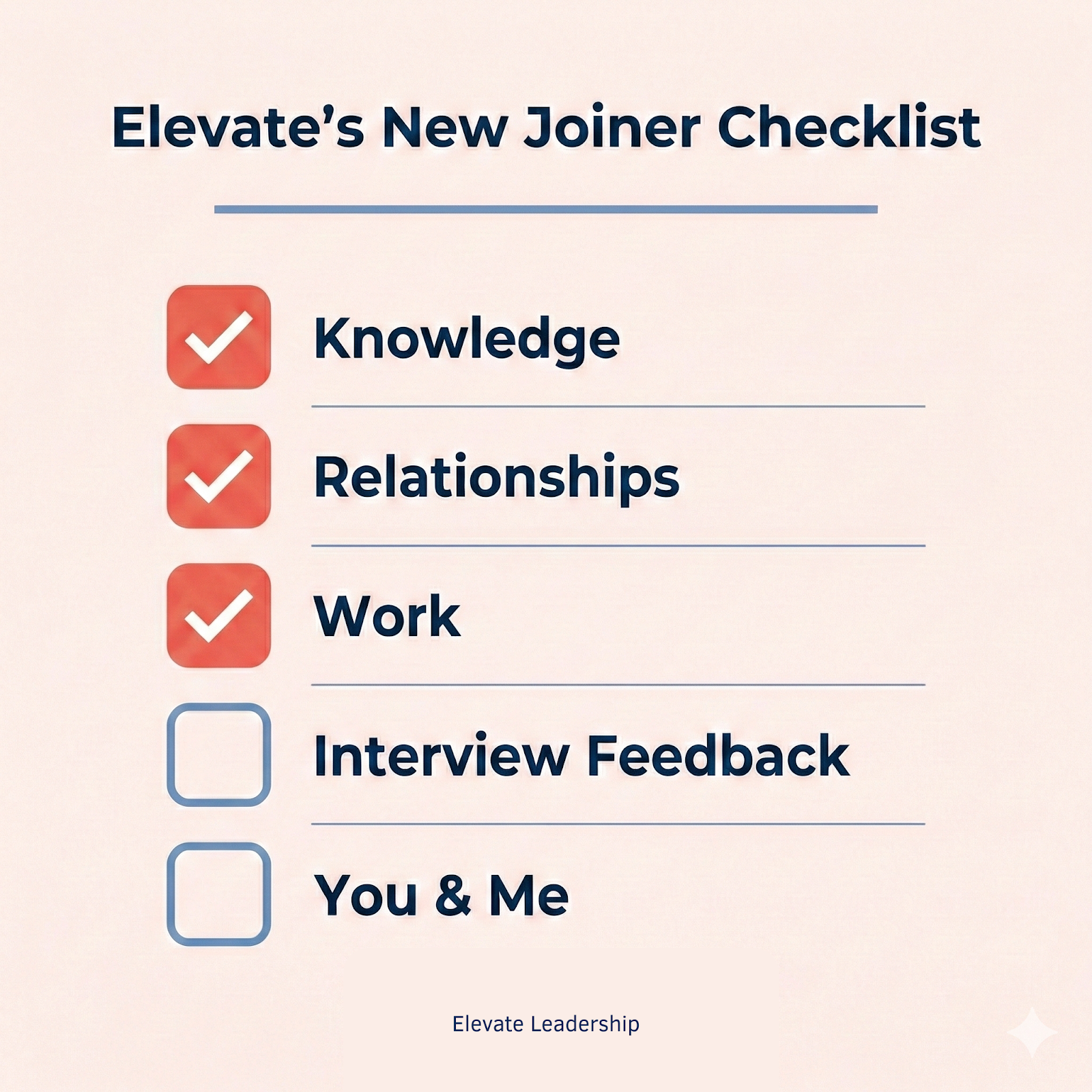
Let’s take a look at a real-world case. We recently coached a client who’s a Head of Sales at a hyper-growth startup. She was hiring a new Account Executive and was anxious about getting it right. She wanted him to feel confident and ramped up quickly, not just "processed".
Together, we built a framework that covered the 5 critical pillars every new hire needs. We call this the Elevate New Joiner Checklist.
Pillar 1: Knowledge
Most managers point new hires to a Google Drive folder and wish them luck. Unfortunately, this is not enough.
- Go Beyond the Handbook: Yes, they need the product docs and org charts. But they also need implicit knowledge.
- The "Why": Explain the company culture, the unspoken norms (e.g., "We don't do internal emails on weekends"), and the deeper "why" behind the team's mission. Context allows them to navigate the organization faster.
Pillar 2: Relationships
Onboarding is fundamentally about feeling connected. Don’t expect a new hire to build a network from scratch in week one.
- Map the Stakeholders: Don't just give them a list of names. Explain why these people matter. "You need to know Reyna in Marketing because she controls the budget for your campaigns."
- Facilitate Introductions: Set up the initial coffees. It removes the friction and social anxiety of reaching out cold.
Pillar 3: The Work
Nothing kills engagement faster than "shadowing" for 3 weeks without contributing.
- Define Success: Clearly articulate what success looks like in this specific role.
- The Quick Win: Assign bite-sized projects early on. For our client’s hire, it was "Audit this specific sales deck and give me three thoughts". This creates immediate momentum and makes them feel like a contributor, not a burden.
Pillar 4: Interview Feedback
This is a unique Elevate insight that most managers miss.
- Share the Panel's Thoughts: In your first or second 1:1, sit down and share the summary of feedback from their interview panel.
- Why It Matters: It builds massive trust. It shows you were paying attention, and it helps them lean into their identified strengths immediately while being aware of their growth areas from Day 1.
Pillar 5: You & Me
Take the guesswork out of the most important relationship they have, the one with you.
- The "How to Work With Me" Guide: Be explicit about your style. For example, "I tend to send emails on Sunday nights to clear my inbox, but I never expect a reply until Monday morning."
- Set Expectations: Clearly define the cadence for 1-on-1 meetings, how you like to receive updates, and how they can best manage up to you.
{{blogcta4="/style-guide"}}
Structuring the Onboarding Journey: The First 90 Days
To prevent the "sink or swim" phenomenon, managers need a structured roadmap. Here’s an example of a roadmap based on Elevate’s New Joiner Checklist across the first 90 days.
Pre-Boarding
- Goal: Ensure the new hire feels expected, prepared, and excited before walking in the door.
- KPIs:
- Tech and system access credentials verified and ready for Day 1.
- "Manager Manual" (Pillar 5 of the Checklist) sent and read by the new hire.
- Welcome email sent to the team introducing the new hire's role and background.
Week 1: Connection Over Content
- Goal: Establish psychological safety and a clear understanding of the role's purpose using our New Joiner Checklist.
- KPIs:
- Complete the deep-dive meeting covering the "5 Pillars" (Knowledge, Relationships, Work, Feedback, You & Me).
- Meet with the assigned Onboarding Buddy at least once for an informal check-in.
- Schedule and attend initial intros with 50% of the key stakeholders on their relationship map.
Weeks 2 - 4: The "Quick Wins" Phase
- Goal: Build confidence and momentum through the successful completion of "bite-sized" contributions.
- KPIs:
- Deliver the first Quick Win project (e.g., audit a deck, fix a bug, draft a comms piece).
- Review interview feedback with the manager to align on strengths and blind spots.
- Demonstrate ability to navigate internal knowledge bases without manager intervention.
Days 30 - 60: The Ramp Phase
- Goal: Transition from learning the job to performing the job with increasing independence.
- KPIs:
- Take full ownership of a specific recurring workstream or mid-sized project.
- Shift 1:1 conversations from "instructional" (how do I do this?) to "strategic" (here is my plan).
- Identify one area of the company culture or workflow where they need more clarity.
Days 60 - 90: Full Integration
- Goal: Operate as a fully integrated team member who contributes to team strategy.
- KPIs:
- Complete a 90-day "Launch Review" to officially graduate from onboarding.
- Establish formal quarterly performance goals (OKRs/KPIs) for the next cycle.
- Provide "Fresh Eyes" feedback: Submit one suggestion to improve a team process or ritual.
Role of AI in Onboarding

We can’t talk about onboarding without talking about AI. But let’s be clear, AI is the enabler, not the solution.
The ROI of AI automation is undeniable. Case studies by SuperAGI have shown that companies using AI-powered-onboarding are seeing 82% of new hire retention boosts.
However, the secret is knowing what to automate.
We recommend using your HRIS and AI tools for the logistical heavy lifting, the so-called "boring, repetitive stuff".
No manager should be chasing signatures manually, playing email ping-pong to schedule first-week intros, or answering basic questions about benefits guides.
By offloading these repetitive tasks to automation and AI chatbots, you buy back time for what actually matters, which is connection.
You simply cannot automate a warm welcome, psychological safety, or the feeling of being "seen" by a new boss. Use technology to handle the process so you can focus entirely on the person, and never let the tool replace the relationship.
Be the Leader Who Makes Their First 90 Days Count
Great onboarding doesn't happen by accident. It happens by design.
When you invest in a structured, connection-first onboarding process, you are telling your new hire: "You belong here, and we are invested in your success."
We know that management is learned. You don't have to be a perfect manager to onboard well; you just need to be prepared and present.
By using the Elevate New Joiner Checklist, you can turn a stressful transition into a powerful launchpad for retention and performance.


