


Think about the last big decision you had to make at work. Did you feel confident walking into it, or did you feel a knot in your stomach that stuck around long after you'd made the decision?
If it's the second, you're not alone. A global study by Oracle found that 85% of business leaders reported suffering from decision distress in the past year, that feeling of regret, guilt, or doubt that lingers after a decision's already been made.
Strategic decision making is a skill, and like any skill, can be built through a repeatable process, instead of whatever your gut says under pressure.
That's what this framework gives you. A structured, 4 phase approach to making decisions that hold up even when the stakes are high.
What is Strategic Decision Making?
Strategic decision making involves making decisions at the right time, with the right information, and with the right people.
It sounds simple, but each of those three pieces is where things usually go wrong.
With the correct approach, decision making becomes the primary mechanism your organization uses to keep its short-term moves lined up with its long-term mission.
Why Are Effective Strategic Decisions Important?

For you as the manager, getting decisions right stops small operational hiccups from turning into full-blown crises.
When you make a quick, well-thought-out call, you're showing your team accountability and emotional intelligence in the same breath.
The more you practice this, the more decisive and adaptable you become, which pays off in every part of your growth as a leader.
For your team, a structured decision making approach removes friction. When roles and responsibilities are explicit instead of assumed, people collaborate faster and projects actually move.
For the organization, this is where it gets serious. The ability to make high-quality decisions quickly is one of the biggest engines of competitive advantage a company has.
A McKinsey survey of more than 1,200 global business leaders found that inefficient decision making costs a typical Fortune 500 company 530,000 days of managers' time every year. That works out to about $250 million in annual wages, spent on decisions that dragged on too long or never got made cleanly.
Solid decisions also keep your day-to-day operations pointed at your long-term vision, which protects your competitive position and makes sure your resources go where they should.
Elevate’s 4 Phase Decision Making Framework
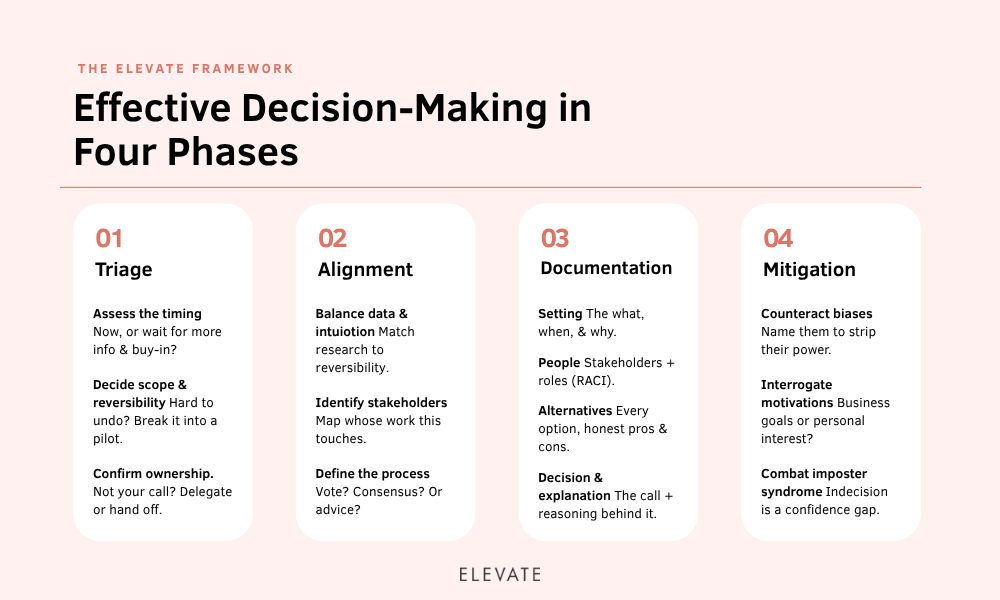
So how do you actually put structure around decision making? We use a 4 phase framework with our clients. This works for everything from a hiring decision to a full strategic pivot.
Phase 1: The Triage Evaluation Phase
Before you commit to a decision, run it through 3 checks first:
- Assess the timing. Ask whether this choice needs to happen today or if you can wait for more information or buy-in. The right decision made at the wrong time often plays out as the wrong decision.
- Determine scope and reversibility. Ask how painful it would be to reverse this once it's done. If it's hard to reverse, break it down. Run a pilot, test a small piece of it, or make a smaller estimate first instead of committing to the whole thing at once.
- Confirm ownership. Ask whether you're actually the right person to make this call. Check it against your direct goals and responsibilities. If it's too granular for your role, delegate it to a direct report. If it doesn't touch your core objectives, pass it to the right cross-functional colleague instead.
Not every decision deserves the full framework. Some fail triage and get delegated, deferred, or broken down before you ever reach Phase 2.
Phase 2: The Alignment Phase
If a decision passes triage and turns out to be genuinely complex, this is where you build the structure around how it actually gets made.
- Balance data and intuition. Match how much research you gather to how reversible the decision is. Talk to people who've faced a similar problem before. But don't drown in data either. Your intuition is subconscious pattern matching built from real experience, and it still deserves a seat at the table.
- Identify stakeholders. Map out exactly whose daily work, direction, or goals this decision will touch. Miss someone here and you'll be revisiting the decision later, usually at a worse time.
- Define the process. Pick how this actually gets decided. Voting, consensus, or gathering advice all work depending on the situation. For decisions involving a lot of people, use a RACI chart. Assign who's Responsible for execution, Accountable for the outcome, Consulted for advice, and Informed of progress.
{{blogcta3="/style-guide"}}
Phase 3: The Documentation Phase
Complex decisions fall apart when the reasoning behind them lives in people's heads instead of somewhere everyone can see. The fix is a SPADE memo, circulated and kept up to date as the decision develops.
- Setting. State the what, when, and why of the decision in plain terms.
- People. List every stakeholder and their exact role. This is where your RACI chart from Phase 2 lives.
- Alternatives. Lay out every real option on the table, with the honest pros and cons for each.
- Decision and Explanation. Write your initial hypothesis. Once the data's in, finalize the decision and document the specific reasoning that got you there, not just the outcome.
Phase 4: The Mitigation Phase
This phase is what protects you from decision distress, that regret or guilt that shows up after a call is made. It comes down to guarding against 3 things:
- Counteract implicit biases. Bring them into your conscious awareness on purpose, because that's what strips them of their power. Watch for loss aversion, confirmation bias, anchoring on whatever information you heard first, framing bias, and the sunk cost fallacy.
- Interrogate your motivations. Ask yourself honestly whether this decision serves your actual business goals, or whether it's really about personal interests or doing someone a favor.
- Combat imposter syndrome. Indecision is often just a confidence problem wearing a disguise. If you catch yourself second-guessing your own judgment, remind yourself of what you actually know, lean on the data you've already gathered, and ask how a confident version of you would handle this exact moment.
Making Peace With the Decisions You Have to Make
Think of a decision you're avoiding right now, or one that's still keeping you up at night.
Which phase of this framework would actually help?
Maybe you haven't confirmed it's even yours to decide. Maybe you know it's yours, but you've never mapped who else it touches. Maybe the real problem isn't the decision at all, it's that you've been quietly doubting your own judgment the whole time.
That's worth naming honestly, because the leaders who make peace with their decisions are the ones who've built a process that catches that doubt before it turns into distress.
Here’s a quick recap of the framework:
- Triage the decision first. Check the timing, the reversibility, and whether it's really yours to make.
- Align on data, stakeholders, and process before you commit.
- Document everything in a SPADE memo so the reasoning outlives the meeting.
- Mitigate your own biases, motivations, and self-doubt along the way.
None of this makes decision making easy. It just makes it clear. And clear is what turns a stressful call into one you can stand behind, whatever the outcome.
{{blogcta4="/style-guide"}}


