


If you've ever ended a week knowing you meant to prepare for that 1-on-1, meant to give that piece of praise, but somehow never did, you're in good company.
Most managers don't struggle with big tasks that have deadlines. They struggle with the behaviors that have no KPIs or deadlines attached. Giving feedback and praise, responding with empathy, coaching your people.
All of them are crucial skills, yet none of them come with a project plan behind them. The habits of great managers are almost always the ones that nobody is tracking.
These behaviors make up around 40% of the actions you take automatically in a day. We call them ‘habits’.
Left unchecked, habits drift into patterns that quietly drain your energy and eat your time. But hundreds of studies have shown we can take control of our habits and set them up to work in our favor instead.
In this piece, you'll learn what a habit actually is, how it forms, and how to build or break one. Then we'll walk through the 5 most underrated habits we see in great managers, so you're ready to build the habits that truly move the needle.
What is a Habit?
A habit is a routine or behavior you repeat so often that it starts happening automatically, without conscious thought. It can be something you do, or a way you think, ingrained through sheer repetition.
Habits cover far more of your management than you'd expect. For example, how you open a conversation, how you deliver feedback, whether you interrupt or wait. Those are patterns you laid down years ago without consciously deciding.
We all know management is a learned skill. But learning is only half the job. You can finish a workshop knowing exactly what to say, yet default to your ingrained habits the moment you're under pressure.
A skill only becomes yours once you've consciously applied it enough times that it runs on its own.
How Do Habits Form?
Charles Duhigg, the investigative journalist behind The Power of Habit, puts it simply, “Habits can be changed once we understand how they work.”
So here's how:
Habits form through neuroplasticity, your brain's ability to change its own structure in response to experience. Every time you repeat a behavior, the neural pathway underneath it gets stronger and more efficient.
The habit loop is a three-part brain process that turns repeated actions into automatic routines, with one element that keeps the cycle going.
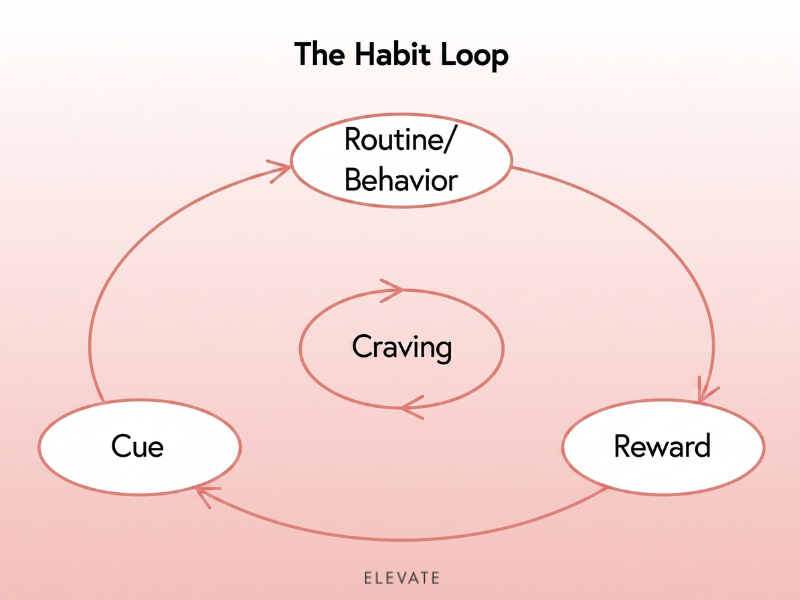
- The cue. The trigger that starts the whole thing. It might be a place, a time of day, an object, or an emotion.
- The routine. The behavior itself. Your brain has stored the details, so you execute it without thinking. You reach for your phone, open a social app, start scrolling.
- The reward. The hit of relief or pleasure afterwards. Dopamine gets released, and your brain files the whole sequence away as worth repeating.
- The craving. Run that loop enough times and your brain stops waiting for the reward. They start releasing dopamine the moment the cue shows up, in anticipation. That's the part that makes a habit feel like a pull rather than a choice.
Now apply that to your management.
Your direct report brings you a problem and looks upset. That's a cue. You jump straight into solving it. That's the routine. The problem feels handled, you feel useful, and you move on to the next thing. That's the reward.
Do it 50 times and you're no longer deciding to fix things. You just do, before you've registered that the person in front of you wanted to be heard first.
The loop doesn't care whether the habit is serving you. It only cares that it's been repeated. Which is exactly why the loop is also where you get your leverage when it comes to building good habits and breaking bad ones.
{{blogcta4="/style-guide"}}
How to Build Good Habits (or Break Bad Ones)
If the loop is what runs the habit, then building a habit is a matter of designing your own loop on purpose instead of letting one form by accident.
At Elevate, we write an “Implementation Intention”
The process is simple, with studies finding these are highly effective for starting a habit and sticking with it.
It goes like this:
"At [time or event] I am going to [routine] in [location] and [reward] will be my reward."
So instead of "I should really prepare better for my 1-on-1s," you write: "At 4pm every Thursday I'm going to write three things I want to cover in tomorrow's 1-on-1s at my desk, and a cup of coffee will be my reward."
Notice what changed. The good intention had no cue, so nothing was ever going to trigger it. The second version has a specific moment attached to it, so your brain has something to hook onto.
The strongest cues are things you already do reliably. Your Monday team meeting ending, your calendar reminder, sitting down after lunch. You're borrowing a trigger that already works rather than hoping you'll remember.
But what do you do when you fall off the wagon?
Everyone does, usually in week three when something urgent blows up your week.
James Clear, author of Atomic Habits, offers 3 questions to ask ourselves when a habit isn't sticking. Each one maps onto a different piece of the loop.
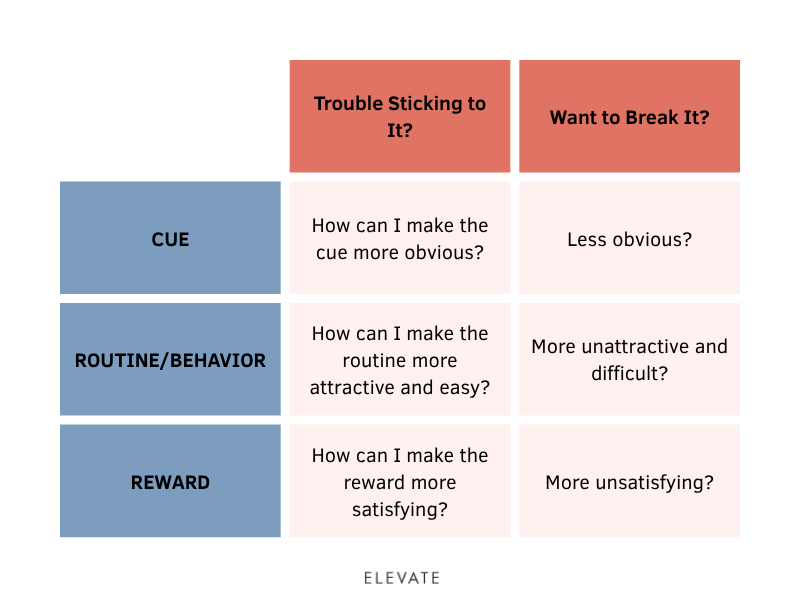
- How can I make the cue more obvious? Or less obvious, if I'm trying to break the habit.
- How can I make the routine more attractive and easier? Or less attractive and difficult, if I'm breaking it.
- How can I make the reward more satisfying? Or less satisfying, if I'm breaking it.
We coached a VP who kept meaning to end her 1-on-1s five minutes early to leave room for the conversation people actually wanted to have. It never happened. Her cue was invisible, so she set a recurring alarm labelled "leave the space." That's question one, and that was the whole fix.
Breaking a habit works the same way in reverse.
If you check Slack every time you open your laptop, you're not going to win that one on willpower. Log out of the desktop app. You've made the cue harder to reach and the routine more effort, which is question one and two doing the work for you.
5 Most Underrated Habits of Great Managers
Now for the habits themselves. These 5 come up again and again in our coaching sessions, and they have one thing in common.
Every one is small, quick, and completely invisible on a to-do list. Nobody will chase you for them. Nobody will notice the week you skip them. Yet every manager we’ve coached believes these habits are foundational to their success.
1. Preparing for Your 1-on-1s
Almost nobody prepares for their 1-on-1s. It's easy to see why. You know your people well, you'll figure it out in the room, and you'll do it the way you always have.
That's the greatest opportunity managers miss. A 1-on-1 is often the only private moment your employee gets to find out whether you noticed their work, whether their opinion counts, and whether you actually value them. Show up distracted and unprepared, and the signal you send is "I don't care about you."
The trouble is timing. The obvious cue is 5 or 10 minutes before the meeting, but real preparation takes more thought than that.
The fix is to use an Implementation Intention to build a better cue.
We had a client, a director with 9 direct reports, who kept meaning to prepare and kept not doing it.
Her implementation intention was this: "At 4pm on Thursday I'm going to spend 15 minutes writing one note per person for next week's 1-on-1s at my desk, and I'll make a fresh coffee before I start."
15 minutes for 9 people. Not a script, just one thing she wanted to make sure she said to each of them. She told us the meetings changed within a month, because she stopped arriving empty-handed.
2. Leaving the Silence
Most people fill silence on instinct. Someone pauses mid-thought, and within a second or two they jump in with a question, a suggestion, or a reassurance. It feels helpful, and like they’re keeping the conversation moving.
What it actually does is take the thinking away from the person. Silence is where people work out what they really mean, especially in a coaching conversation.
The pause right after you ask a question is often the moment they're deciding whether to give you the safe answer or the honest one. Jump in too early and you've handed them the safe answer without meaning to.
The cue here is the silence itself, and your instinct is to treat it as a problem to solve rather than a signal to wait. So this habit is something you hold back from doing rather than something you add.
Here’s a quick tip on how to build it: Count to 5 in your head before you speak again. Long enough to feel uncomfortable, which is usually the sign it's working.
We had a client who described herself as a natural interrupter. She couldn't stop filling silences even when she noticed herself doing it.
Her Implementation Intention was: "When I ask someone a question in a 1-on-1, I'm going to count to 5 in my head before I say anything else, and their answer will be my reward."
She told us the first few times felt unbearable. Then she started hearing things her team had never said to her before, because she'd finally left them the room to say it.
3. Remembering the Little Things
"You mentioned you were taking your dog to the vet on Tuesday. How's he doing?"
That's it. That's the whole habit.
It costs you nothing, and it lands enormously. It tells someone you were actually listening, and that they stayed in your head after they left the room.
Most managers mean to do this. Almost none actually do, because by the next day the detail is gone, buried under everything else that's happened since.
The cost of not doing it is nearly invisible, which is exactly why it's easy to ignore. Nobody complains that their manager forgot about the vet appointment they casually said.
But over months, forgetting the small things tells people they're a resource to you rather than a person. Remembering does the opposite. It's one of the cheapest ways there is to build real trust.
This habit needs two cues, because it happens in two moments.
The first is capturing the detail before you lose it. We had a client, a manager who genuinely cared about his team but kept losing these details in the noise of a normal week.
His Implementation Intention was this: "At the end of every 1-on-1, I'm going to write one personal note about what they told me in my notes app, and closing my laptop will be my reward."
The second is actually saying it next time. Writing it down doesn't help if it stays in the notes app.
So the same manager built another Implementation Intention: "At the start of every 1-on-1, before we talk about work, I'm going to check my note from last time and ask about it, and their reaction will be my reward."
If your manager remembered one small thing you mentioned last week, how would that change how you feel about them?
That's the power of this habit.
4. Praising People

"Do I really have to praise someone for just doing their job?" The answer is: YES!
It's counterintuitive, because praise feels like it should be reserved for the exceptional. But it matters the most for the people who aren't yet going above and beyond, because praise reinforces the exact behavior you want to see more of.
Skip it and you're quietly telling your high-performers that showing up and doing good work goes unnoticed.
It's also quick. Using our Four-Point Praise Structure (how you felt, the specific behavior, the wider impact, a quick thanks), you can run the whole thing in about 30 seconds.
This needs to be a habit rather than a good intention because if you leave it for when you "feel like it," it happens roughly never. Praise has no deadline, so without a cue, it competes with everything else on your plate and loses.
We had a client who kept a spreadsheet with a target of ten praises a week, tracking how many each person had received. It sounds extreme. But it worked beautifully, because the spreadsheet became the cue itself.
Her implementation intention was this: "Every morning when I open my laptop, I'm going to check who's below their praise count and send one message before I open my inbox, and imagining their smile will be my reward."
5. Responding with Empathy
Someone comes to you upset, and your instinct as a manager is to fix it. You've got the answer half-formed in your head before they've finished the sentence.
It's almost always the wrong first move. People can't hear a solution while they're still flooded with emotion. You're talking, but nothing's landing, because their brain is busy processing the feeling.
Responding with empathy is actually the fastest way to de-escalate an emotional situation. It’s because emotions don’t dissipate until they’re acknowledged.
This habit has an obvious trigger: someone comes to you upset.
So your Implementation Intention could be: “When my direct report comes to me upset, I’m going to acknowledge their feelings before I say anything else, and a five-minute break afterwards will be my reward.”
Building the Habit That Sticks
None of these 5 habits will show up on a performance review. Nobody will ever thank you specifically for leaving the silence, or for writing down a note about someone's dog. But your people notice when you do them, because that's how they can tell you actually care.
That's exactly why they're worth building on purpose.
Which one of these are you already half-doing or have always wanted to do? How can you make the cue more obvious, or the routine more attractive and easier, or make the reward more satisfying?
Quick recap of the five habits of great managers:
- Prepare for your 1-on-1s
- Leave the silence
- Remember the little things
- Lead with empathy before advice
- Praise the basics
Pick one, write your Implementation Intention today, and attach it to something you already do reliably. You don't need all five at once, you just need the first one to actually stick.
{{blogcta3="/style-guide"}}


