


You're 20 minutes into your team meeting and the room has gone flat. The project's behind and nobody is saying much.
Do you tighten the plan and reassign the work, or step back and remind everyone why this project matters?
The lead vs. manage question sounds academic until you're the one in the room. Push too hard on process and your best people feel micromanaged. Stay too far above the detail and work quietly stops shipping.
So when exactly should you lean in to manage or step back to lead?
That’s what this article covers. You’ll learn what management and leadership really mean, where they overlap and differ, and 3 ways to decide which hat to wear in the moment.
Leadership vs. Management
Leadership and management are two distinct disciplines that work together. Leadership sets the destination and the culture. Management builds the processes and day-to-day alignment that get a team there.
What Is Leadership?
A leader is anyone who deeply influences a team's culture, norms, standards, and strategic direction. People model their behavior on a leader and look to them for cues about which goals really matter.
Leadership anchors on the "why" and the general "how." The purpose behind the work, and the values that shape how the work gets done. Today's leaders build psychologically safe environments and empower people to move toward a shared goal.
Two things worth noting. Leadership is learned, so nobody arrives fully formed. And you don't need direct reports to be a leader.
What is Management?
As Julie Zhuo puts it in The Making of a Manager, a manager's role is to get better outcomes from a group of people working together. At its core, management is about getting things done.
Management owns the "what" and the specific "how". Roles, responsibilities, targets, workflows, and communication cadences. It's a distinct role centered on enabling the success of others.
Leaders establish the strategic destination and the cultural environment. Managers implement what's needed to reach it.
Most managers need strong leadership qualities to succeed, though not every leader needs to be a people manager.
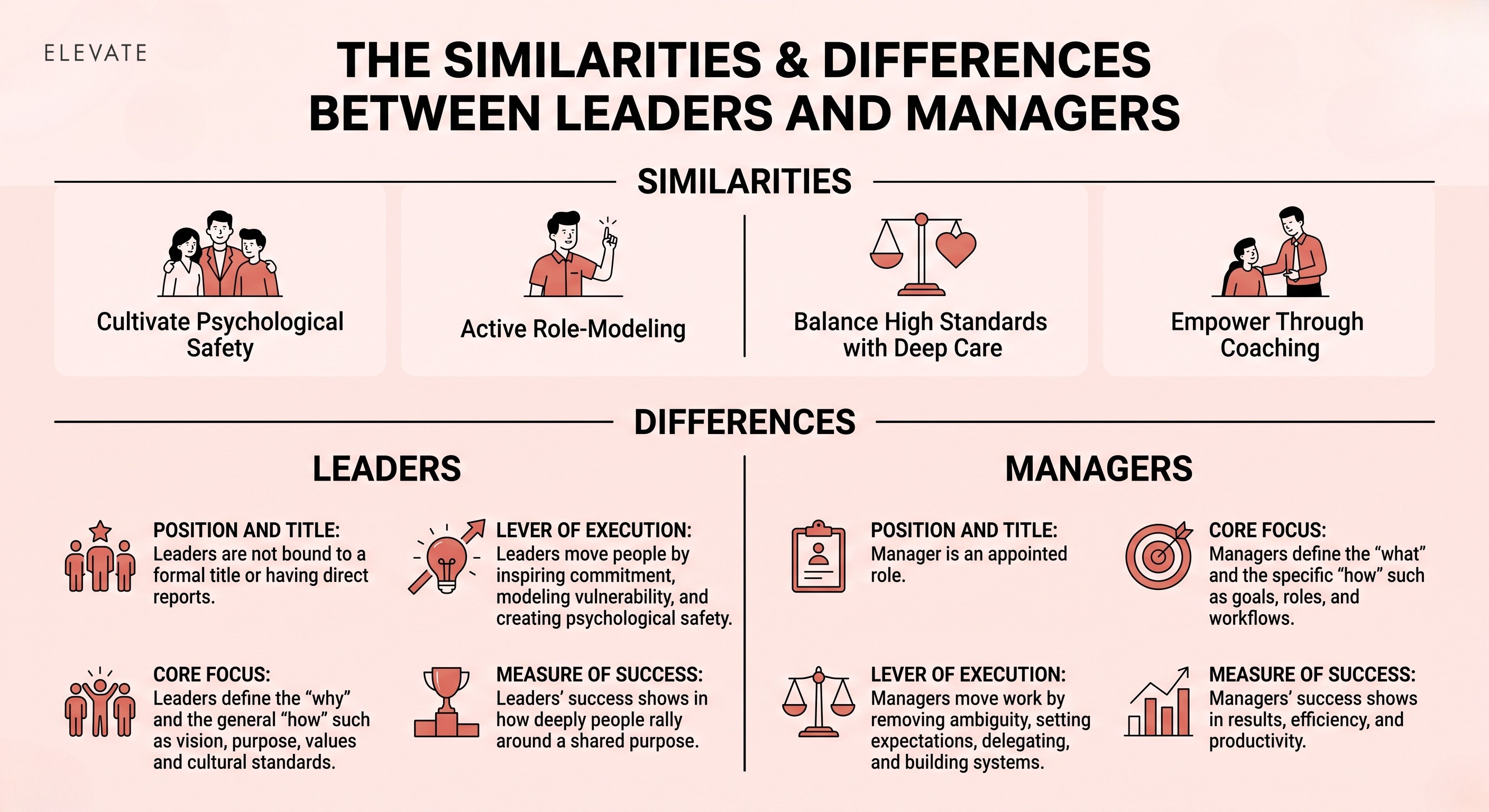
The Similarities between Leaders and Managers
Leadership and management may serve different purposes, but both depend on how you show up with your team. The same 4 behaviors are foundational to both roles:
1. Cultivating psychological safety: Amy Edmondson, Professor of Leadership at Harvard Business School, introduced the construct of team psychological safety and defines it as a shared belief that the team is safe for interpersonal risk-taking.
Whichever hat you're wearing, your job is to build an environment where people speak up, ask obvious questions, float half-formed ideas, and admit mistakes without fear of humiliation.
2. Active role-modeling: People take behavioral cues from you constantly, and far more from what you do than what you say.
We coached a VP who kept telling her team it was fine to disagree with her, then visibly stiffened every time someone did. The team read the stiffening, not the invitation. Humility, emotional balance, and accountability all have to be visible before anyone believes they're safe to model from you.
3. Balancing high standards with deep care: Both roles require pairing clear performance expectations with genuine listening and real concern for how people are doing. Drop the standards and you get a pleasant team that underperforms. Drop the care and you get compliance, then attrition.
4. Empowering through coaching: Leaders and managers both get more out of people by asking open questions and holding space for others to be resourceful. The instinct to jump in with the answer is strong, especially when you know it and you're busy. Resisting is how people grow.
{{blogcta1="/style-guide"}}
The Differences between Leaders and Managers
Leadership and management often overlap, but they aren't interchangeable. Here’s where the two diverge:
- Position and Title. Leadership isn't bound to a formal title or to having direct reports. Anyone can step up as a leader by influencing culture and modeling the standard. Management is an explicit role with direct responsibility for coordinating a specific group of people and their collective output.
- Core Focus Leaders define the "why" and the general "how." Vision, purpose, values, and cultural standards. Managers translate that into the "what" and the specific "how." Concrete goals, roles, workflows, and communication cadences.
- Time Horizon. Leadership means lifting your head out of the weeds to keep a wide view on industry shifts, future challenges, and multi-year objectives. Management lives in the near term. Quarterly goals, bi-weekly check-ins, and unblocking whatever's stuck today.
- Primary Lever of Execution. Leaders move people by inspiring commitment, modeling vulnerability, and creating the safety that makes healthy risk-taking possible. Managers move work by removing ambiguity, setting expectations upfront, delegating, and building systems that scale beyond their own attention.
- Measure of Success. A leader's impact shows in how deeply people rally around a shared purpose and adopt high standards. A manager's success shows in the results, efficiency, and growth of the team.
This last one catches people out. We've coached plenty of managers who felt like frauds because they weren't inspiring anyone, when their team was shipping brilliantly and every person on it had grown that year. That's the scoreboard for management, and it counts.
The real question is which hat the moment in front of you needs. Working that out is the tricky part.
3 Ways to Decide When You Should Be a Leader or Manager
Great leadership depends on context, so use these 3 practical methods to work out which hat to wear.
1. The "Why" vs. "What" Operational Diagnostic
Start with the type of problem your team is facing.
Lead when the problem is a "why" problem. Ambiguity, low morale, organizational change, strategic uncertainty. Lift your head out of the weeds and connect the daily work to the bigger purpose.
Manage when the problem is a "what" problem. Execution stalls, deadlines slip, two people think they own the same task. Set explicit expectations, define measurable goals, and tighten how the team communicates.
The trap is treating one as the other. We coached a founder who kept rallying his team with vision talks while three roles quietly overlapped. The energy lifted for a day, then the same work collided again. What his team needed was someone to say who owned what.
2. The Skill/Will Task Assessment
The second method looks at the skill vs. will of the individual you’re leading relative to a specific project or major task.
Assess each direct report per project, not in general. Skill is their competence at this specific task. Will is their motivation for it. Someone can be high on both for one project and low on both for the next.
If it’s low skill, low will: manage closely. Give step-by-step instruction, set tight boundaries, and check in often to manage poor performance. Then get curious about the low will, because it's usually fixable once you know whether it's the work, the workload, or something outside the office entirely.
If it’s low skill, high will: manage as a teacher. They want this, so protect that. Structure the task, show them how, and let them try the next piece themselves with a safety net under it. Praise progress rather than perfection, or you'll flatten the will you're relying on.
If it’s high skill, low will: lead. They can do it and they've stopped caring. Directive management here reads as an insult and can make things worse. Use open questions to find out what changed, reconnect the work to something they actually want, and consider giving them exposure or ownership that stretches them again.
If it’s high skill, high will: lead, then get out of the way. Delegate the outcome instead of the steps. Coach with the GROW model rather than instruct, hand over real autonomy, and give them visibility with senior leadership.
3. The "Gorillas vs. Monkeys" Time Horizon Audit
“Monkeys” are the small, urgent, noisy things. Operational to-dos, tactical unblocking, the bi-weekly check-in. Handle these cleanly as a manager and move on.
“Gorillas” are the big things that never shout. Mapping a two to three year vision for your team, restructuring how work flows, reading the pattern in your industry. Nobody chases you for these, so they lose every single day to the monkeys unless you defend the time in your calendar.
If your week is all monkeys, that's your answer. You've been managing and you haven't led in a while.
So think about your ideal workweek. How many of those hours should be gorillas? If you want to lead more often, pick one gorilla and give it a recurring slot this week.
Lead vs Manage: Which Hat Will You Wear Tomorrow?
When you're genuinely unsure which hat to wear, pause and ask yourself one question, “What is most needed of me right now?” If your team needs clarity and structure to execute, manage them. If they need purpose and autonomy, lead them.
3 ways to get to that answer faster:
- Diagnose the problem. "Why" problems need a leader. "What" problems need a manager.
- Read skill and will for each project, and flex to what that person needs on that task.
- Audit your week. Monkeys get managed. Gorillas get led.
The managers who get this right pay closer attention than everyone else in the room. That attention is the whole skill, and you can start using it in your very next meeting.


