


You know you need to delegate more. Maybe you've even promised yourself to learn how to delegate effectively this quarter. Then Monday arrives, a project lands on your desk, and a familiar voice says, "It'll be quicker if I just do it myself."
That voice has a point. You're good at this work. That’s what got you promoted. But when the results rest on your shoulders, handing the work to someone else can feel like a risk you can't afford to take.
Still, you can’t do everything alone. The State of Delegation 2026 report found that organizations treat delegation as a core capability, one that shapes how well teams execute and how long people stay.
So learning to let go matters for your team as much as it does for you.
In this article, we'll walk you through Elevate's Delegation Matrix, a simple framework for handing over work with confidence. We'll also share tips for the moments when letting go feels hardest.
What is Delegation and Why It Matters?
Delegation means handing over the projects or tasks that keep you from your high-impact work, in a way that empowers your direct reports to take ownership and see them through to completion.
If the other person walks away feeling confident and motivated to do the work, you’ve done a great job. If they leave anxious or unsure, the delegation isn't done yet.
Delegating isn’t the same as assigning tasks. Delegation hands over ownership and decision rights along with the workload. If you pass over a task but keep the context and decisions in your head, the work usually comes back different from what you expected. That's assigning a task.
When you delegate effectively, you get 4 things:
- More time for high-impact work that only you can do. You get the low-impact tasks off your back so you can tackle high-impact tasks that move the needle on your team performance (e.g., interviewing new hires, preparing for 1-on-1s, having career conversations, planning the quarter).
- Improved personal well-being. DDI's Global Leadership Forecast 2025 surveyed 10,796 leaders worldwide and found that nearly 1 in 6 are facing burnout. The skill that did the most to prevent it was delegation, 5X more impactful than any other skill they measured.
- Growth for your team. This is the big one. Delegation is how your direct reports build the skills they need to grow in their roles. It’s a key part of any people development strategy.
- Faster, higher-quality decisions. Aaron De Smet, a senior partner at McKinsey, and his colleagues found that organizations whose leaders empower people through coaching are nearly 4X more likely to make good decisions.
How to Use Elevate's Delegation Matrix
Elevate's Delegation Matrix breaks every handover into 4 boxes: What, Why, How, and Checks. Work through them in order, and your direct report will leave the conversation clear on what's expected and why it matters.
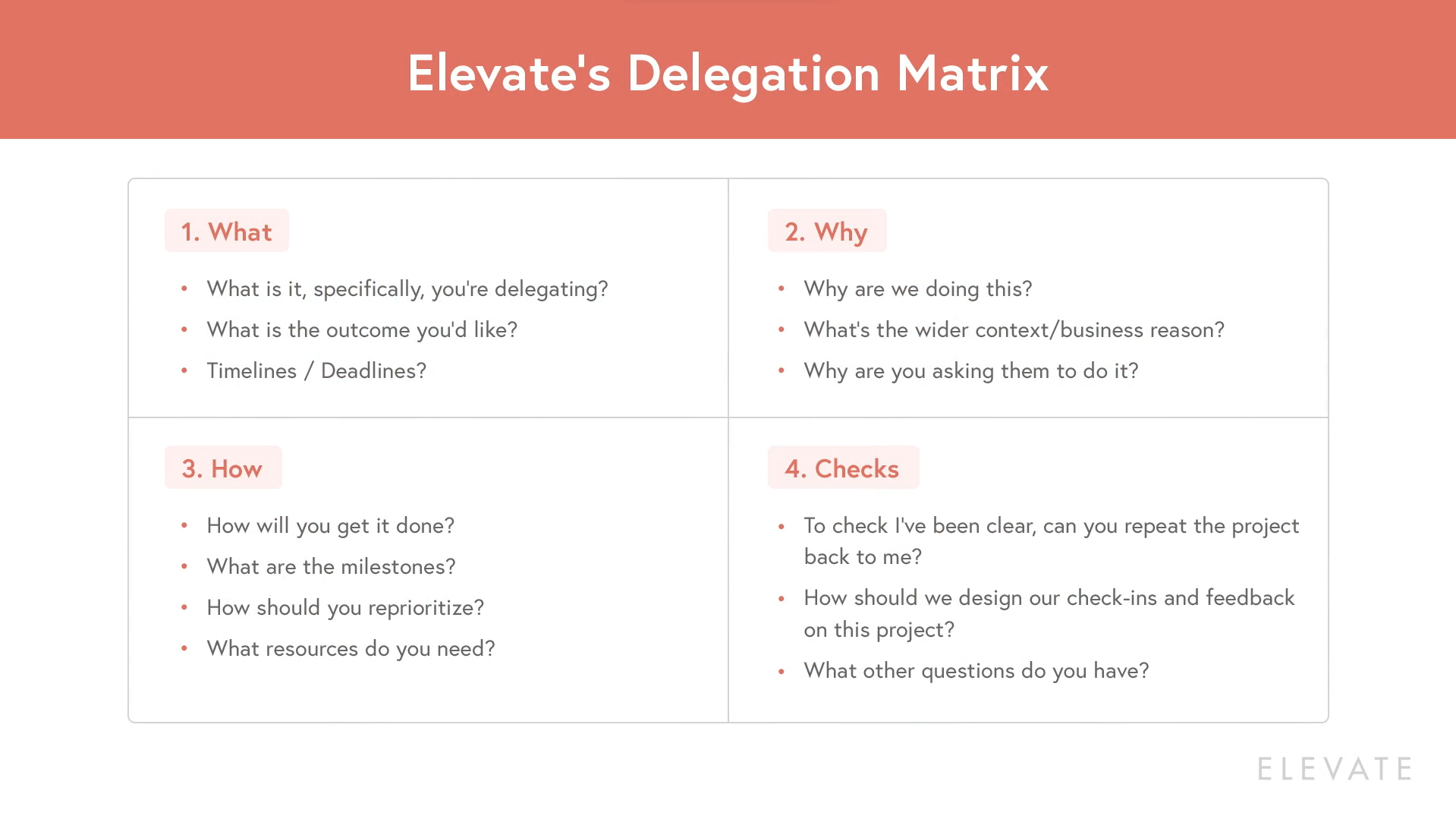
We'll use a simple example throughout: you want a team member to plan and run a virtual happy hour.
Box 1: What
Start by getting specific about the task and the result you expect.
- What exactly are you delegating? State it simply. "I'd like you to plan and lead a happy hour over Zoom. You'll handle the logistics and MC it."
- What outcome would you like? This paints a picture of the end product. "The outcome is that people have fun and learn something about each other."
- What does success look like? Think these through before the conversation so you can set expectations clearly. "If most of the team shows up and stays for the full hour, that's a win."
- What are the timelines and constraints? "Let's make sure it happens in the next month."
Most managers cover this box well. It's the next one they tend to forget.
Box 2: Why
- Why are we doing this? Share the purpose and the wider business context. When they hit an obstacle, context helps them solve the problem without coming straight back to you. "The team is newly assembled, and we need to build connections."
- Why are you asking them? Maybe it's a skill they want to build, or maybe they're simply best placed to help. "I think this is a great opportunity for you to get some visibility with the team."
Up to this point, you've been directive and that's intentional. For the next two boxes, how directive you are depends on the person's seniority and experience.
Box 3: How
- How will you get it done? Ask them to talk you through their approach and ideas before they start.
- What are the milestones? Work back from the end point into smaller goals. "If the happy hour is four weeks out, what needs to happen by the end of week one?"
- How should you reprioritize your current workload to hit the deadline? New work rarely lands on an empty plate. Ask, "What's on your plate right now that might get squeezed by this? What can we push back or hand to someone else?" This question signals that you're adding to their workload with care and respect for their boundaries.
- What resources do you need, and who else could help? "Is there any budget you'll need for games or prizes? Would it help to loop in someone who's run one of these before?" Asking this upfront saves them from stalling halfway through because they didn't feel they could ask.
These questions aren't exhaustive, but dig into the How thoroughly. With a junior team member, have the answers mapped out for them. With someone more senior, pose the questions and let them come up with most of the answers. That's where ownership starts to shift.
Box 4: Checks
Don't skip this box. This is where the delegation sticks and gives you peace of mind.
- To check I've been clear, can you repeat the project back to me? Notice the framing. You're checking your own clarity, so they don't feel tested. People often think they've understood until they say it out loud. That's when the gaps and roadblocks surface.
- How should we design our check-ins and feedback on this project? Agree up front how closely you'll stay involved, so you don't end up hovering over their shoulder for updates. Ask how they'd like to keep you updated and how often. Then agree on what counts as urgent enough to escalate.
- What other questions do you have? What have I missed? Asking what you might have missed makes it easier for them to raise a concern now, instead of getting stuck on it halfway through the project.
{{blogcta3="/style-guide"}}
3 Tips to Delegate Effectively

The Elevate’s Delegation Matrix gives you the structure. These tips help with the barriers that stop managers from using it in the first place.
Tip 1: Challenge Your Excuses for Not Delegating
This is for managers who think, "It's faster if I just do it myself." When you're short on time, training someone feels like a luxury. And when you're the expert, doing the work yourself feels safer.
There's almost always a reasonable sounding reason to hold on to a task. So test it. At the end of this week, list the tasks you did that someone on your team could learn to do. Next to each one, write down why you kept it. Then ask yourself:
- Is this true every time, or just this time? A tight deadline this week is a real reason. A tight deadline every week is a delegation problem.
- What will this cost me over the next 6 months? If a report takes you an hour every week and three hours to teach, you break even in three weeks. After that, you've bought back an hour a week.
- Am I keeping this because it needs me, or because I enjoy it? Be honest here. Tasks we're good at are the hardest ones to let go.
AI can cut down your training time by a lot. Record your screen while you do the task once, talking through your thinking as you go. Then ask an AI tool to turn the transcript into a step-by-step guide your team member can follow and edit.
Tip 2: Treat Letting Go as Trial and Error
You don't need to get the level of autonomy right the first time. Start where you both feel comfortable, see how it goes, then adjust. Think of it as a dial you turn up gradually.
After the first round, ask: "What worked well, and where would you have liked more or less input from me?" Their answer tells you where to set the dial next time. The right setting will be different for each person on your team, and that's fine.
You can let go and still stay in the loop. Keep a standing item on your 1-on-1 meeting agenda for delegated projects so updates come to you without you chasing them (use the Checks box). A shared project tracker helps too, and many tools now use AI to summarize progress, so you can see where things stand at a glance.
Tip 3: Be Open About What You Can't Do
Many first-time managers still measure their worth by what they personally produce, and asking for help can stir up imposter syndrome.
Your team takes its cues from you. If you model that you don't have to do everything yourself, they'll feel freer to ask for help too. Try saying one of these out loud:
- In a team meeting: "I've been holding on to the vendor reviews for too long, and it's slowing us down. Priya, I'd love you to own these going forward."
- In a 1-on-1: "What's something I'm doing that you think you could take off my plate?"
- After a handover goes wrong: "I wasn't clear enough on the deadline last time. Let's walk through the Checks box together before you start."
That last one matters most. Owning your part in a messy handover shows your team that mistakes are part of learning to delegate, on both sides.
Delegating Is How Your Standards Spread
If delegating feels hard, it's because you care. You care about the quality of the work and the results you're responsible for. That instinct has served you well, and it's also what makes letting go so uncomfortable.
We've coached many managers who felt exactly the way you do right now. Most of them worried that handing work over would mean their standards would slip. Instead, their standards spread. Their teams grew more capable, and they finally had room for the work only they could do.
So look at your calendar for next week. What's one task you could hand over, and who on your team would grow the most from doing it?
You don't have to carry everything on your own.
{{blogcta4="/style-guide"}}
FAQs: How Do Managers Delegate Effectively?
What should I delegate, and what should I never delegate?
Delegate recurring tasks that don't need your level of expertise, like weekly reports or meeting logistics. Also delegate work that would stretch someone's skills, such as presenting to leadership or leading a small project.
Keep the work that depends on your role as their manager. That includes performance reviews and tough conversations. Hiring decisions and confidential matters stay with you too.
How do I delegate without micromanaging? How much follow-up is right?
Agree on follow-up before the work starts, using the Checks box. Ask how they'd like to keep you updated and how often. Match check-ins to their experience. A new team member might need a quick weekly catch-up, while someone senior may only need updates at key milestones. If you feel the urge to chase for updates in between, revisit the Elevate’s Delegation Matrix together.
How do I delegate when my team is already overloaded?
Start by clearing space before you add anything. Ask, "What's on your plate right now that we could pause or drop?" You'll often find tasks that no longer need doing at all or can be handed to an AI tool. If your team is genuinely at capacity, delegating more won't solve it. That's a conversation about priorities or resourcing with your own manager.
What do I do when the person makes a mistake or does it worse than I would have?
First, ask yourself whether it's actually worse or just different. If it still meets the success criteria, let it go. If it's a real mistake, get curious before you correct. Ask, "Talk me through how you approached this." Then check your handover. Was the outcome clear? Did you share the why? Let them fix it rather than redoing it yourself.
Am I still accountable if I delegate it?
Yes. You hand over the work and the decisions, but you're still accountable for the outcome. That's why clear expectations and agreed check-ins matter so much. If something goes wrong, take responsibility with your own manager, then work through the fix privately with your team member. Backing them publicly builds the trust that makes them willing to take on the next project.


