


You’ve probably noticed it already. The leadership style that works brilliantly with one person on your team falls flat with another. You give someone space and they flounder. You give someone else detailed instructions and they feel micromanaged.
It’s frustrating, and it can leave you wondering whether you’re cut out for this.
Before you read on, know this. The fact that you’re here means you care about getting it right for your people, and that care is where great leadership starts.
Flexing your leadership style is how you give each person what they need.
Your team is likely a mix of backgrounds and experience levels, so one leadership approach won’t fit everyone. Flexing sounds harder than it is, especially with a model to guide you.
In this article, you’ll learn a model for flexing your leadership style based on the person’s specific need and situation.
What Is Flexing Your Leadership Style, and Why Does It Matter?
Flexing your leadership style means adapting how you lead to fit the person in front of you and the situation they’re in. In practice, you’re turning a handful of dials up or down:
- How much direction you give
- How much support you offer
- How much autonomy you hand over
- How hard you challenge them
- The pace you set
Picture these four people on your team:
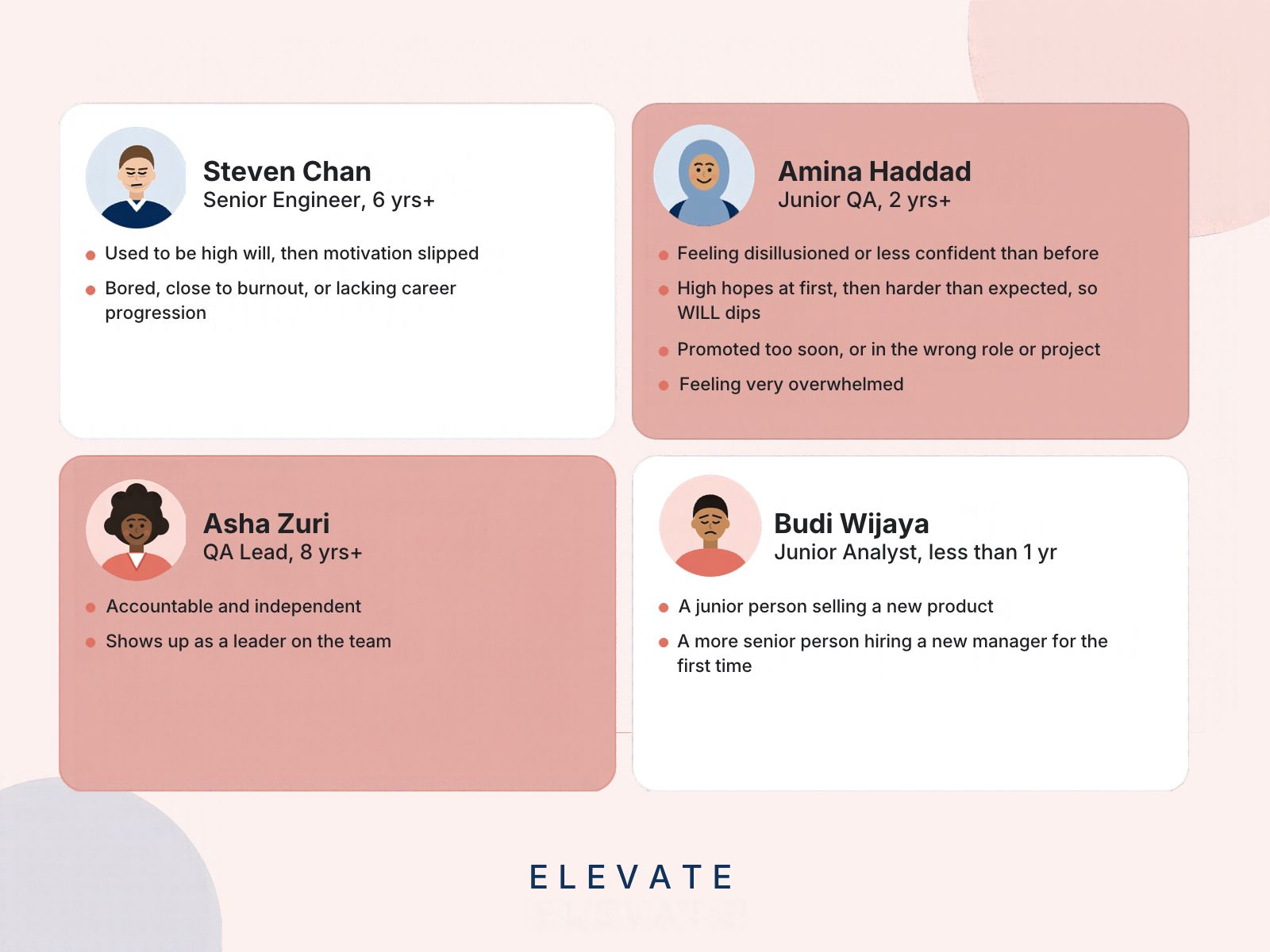
If you lead all of them the same way, someone will lose out.
Flexing your leadership style doesn’t make you inconsistent or mean you’re playing favorites. Your values and standards stay the same.
Here’s the thing: You flex your behavior, not your character.
Flexing asks for judgment about what each person and situation needs, and the willingness to give it to them.
Flexing matters more than most managers realize, because you shape your team’s day-to-day experience more than anyone else in the business.
Gallup’s State of the Global Workplace 2026 Report found that falling manager engagement is the biggest driver behind the recent slide in employee engagement. Of everything that affects how engaged your team feels, how you lead is the most powerful lever you control.
L&D and HR leaders already see the need. In Harvard Business Impact’s 2024 Global Leadership Development Study, a survey of more than 1,100 L&D and business leaders, 70% of respondents said it’s important or very important for leaders to master a wider range of effective leadership behaviors.
When and How to Flex Your Leadership Style: Elevate’s Flexible Management Model
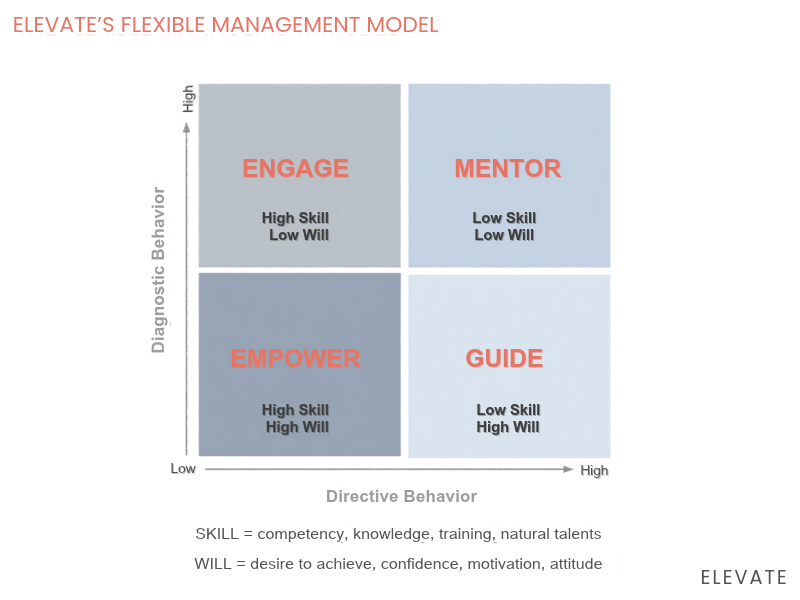
Knowing you should flex is one thing. Knowing when, and which dial to turn up or down, is the hard part. That’s where Elevate’s Flexible Management Model comes in.
It folds those dials into two moves: how directive you are, and how much you diagnose. That gives you a simple way to read what someone needs and takes the guesswork out of flexing.
Where you place someone on the model depends on two things:
- SKILL is their competency. It’s built on knowledge and training, and shaped by natural talent.
- WILL is their desire to achieve. It shows up in their confidence and motivation, and in their attitude and commitment.
The Two Axes: Directive and Diagnostic Behavior
Once you’ve placed someone, the model’s two axes show you which way to flex. The X axis is directive behavior. The Y axis is diagnostic behavior.
When you’re more directive, you’re:
- Giving specific directions
- Providing detailed instructions
- Teaching
- Giving advice
- Solving problems for them
- Providing lots of structure
When you’re less directive, you’re:
- Letting them decide what direction to take
- Giving them autonomy to make decisions
- Holding back specific advice so they come up with the answers themselves
- Coaching rather than teaching
- Resisting the urge to dive in and solve all their problems
The Y axis comes into play when someone is low on will, meaning their confidence and motivation have dipped. That’s when you need more diagnostic tools to:
- Have emotional conversations to understand what’s going on
- Get curious and ask lots of questions
- Check in with them more often
- Increase your empathy, because people low on will need an empathetic ear
As you move down the diagnostic axis, you do all of this to a lesser degree.
Now let’s look at each quadrant and how to flex your leadership style for someone who sits there.
Low Skill, High Will: GUIDE
People often land here when a skill the project needs is brand new to them, but they’re motivated to learn it. That could be a junior person selling a new product, or a more senior person being a hiring manager for the first time. Eager new hires often start here too.
To guide someone, you’ll want to:
- Give detailed instructions
- Closely monitor progress
- Teach them how to do things
- Provide structure so they’re working within clear boundaries
- Give advice
- Pair them with a more skilled person who can help them upskill quickly
Low Skill, Low Will: MENTOR
People here are often feeling less confident or motivated than they used to be. Some people sit here most of the time because they were promoted too soon or put in the wrong role or wrong projects. Feeling very overwhelmed can land someone here too.
Mentoring stays directive, like GUIDE, but turns up the diagnostic behavior.
- Diagnose the low will. It could be something making them unhappy or a lack of support. It might be that they’re feeling unsure of themselves. So dig in. Get curious and ask questions.
- Build momentum with quick wins. Are there smaller projects they can take on to feel progress quickly? Teresa Amabile, a professor at Harvard Business School, found that making progress in meaningful work is the biggest boost to people’s mood and motivation at work.
- Align on team and individual goals. People can feel lost when they’ve drifted off track or can’t see how their work contributes to team and company goals.
- Don’t let them stay here long. No one is effective or happy when they’re low skill and low will. If you’ve tried a lot and aren’t seeing progress, you may need to consult HR or manage poor performance.
High Skill, Low Will: ENGAGE

People usually slip here from high will when something knocks their motivation. Maybe they’ve gotten bored with their work. Maybe they need a vacation and are on the edge of burnout. They might feel their career progression has stalled.
So keep your diagnostic hat on and ENGAGE:
- Diagnose the low will. What’s knocking their motivation or confidence? Coach and listen for where the problem actually sits. It might be the team or the work itself.
- Have a 1-on-1 conversation. Show you’re there and you care. Open by naming what you’ve noticed, without judgment. Resist the urge to fix. Ask, “What would help most right now?” Agree on one small next step before you finish, so they leave knowing you’ll follow through.
- Check for burnout. When did they last take a vacation? Look at their leave balance and watch for warning signs, such as late-night emails or a usually reliable person missing deadlines. Encourage them to book time off, and protect it.
- Identify and develop new skills to bring back a sense of challenge. Ask, “What would you love to get better at in the next six months?” Then turn the answer into development goals to strive for.
Because they’re still high on skill, you can be a lot less directive:
- Share in decision making
- Delegate responsibility
- Give them autonomy
- Coach them rather than teach them
{{blogcta2="/style-guide"}}
High Skill, High Will: EMPOWER
People here can be accountable and independent. They show up as leaders on the team, so you can be much less directive with them.
It’s great when someone lands here, because it frees up your time for others. But don’t leave them alone, because high performers can lose will quickly. Make sure you:
- Keep the challenge high
- Partner with them on their projects and invest time in them
- Increase their exposure to leadership so they feel recognized and valued
- Have a career conversation so they don’t feel like they’re coasting
Start Flexing Your Leadership Style This Week
Flexible leadership takes practice. You won’t read every situation right the first time, and that’s fine. What matters is that you’re paying attention to the person in front of you and adjusting as you go.
Here’s a quick recap:
- GUIDE (low skill, high will): Give clear instructions and structure.
- MENTOR (low skill, low will): Stay directive while you diagnose what’s behind the dip.
- ENGAGE (high skill, low will): Diagnose the root cause of low will, step back on direction, and coach.
- EMPOWER (high skill, high will): Keep the challenge high so they don’t lose motivation.
Try this exercise. Pick one person. Place them on Elevate’s Flexible Management Model. Then have one conversation this week where you lead them the way their quadrant needs.
Small shifts like this add up quickly.
Every time you flex, you’re showing someone that you see them and you’re invested in their growth.
Trust your judgment. You know your people better than any model does.


