


Think about the last time you felt deeply frustrated by an employee's performance. You thought you were on the same page. You thought the goal was obvious. But the final result completely missed the mark.
What went wrong? Usually, it’s not a lack of talent or motivation. In our years coaching executives and leaders, not setting expectations explicitly is one of the most common failure points we see.
We hire brilliant people and assume they will naturally know how to navigate the role. We leave our expectations unspoken, assuming they’re implied. But unspoken expectations can give your team anxiety. They force employees to guess what success looks like, which inevitably leads to misaligned work, micromanagement, and burnout.
At Elevate Leadership, we believe that who you work for is everything. And one of the greatest gifts a leader can give their team is the gift of absolute clarity.
Learning how to set expectations as a manager is about creating a psychologically safe environment where people know exactly what it takes to win. When you master the art of setting expectations as a manager, you remove the guesswork and unlock your team's true potential.
In this guide, we’re going to break down the exact anatomy of workplace expectations. We’ll look at why clarity is the ultimate driver of employee engagement, and walk you through Elevate’s Expectations Pyramid, a practical framework you can use today to get your team perfectly aligned.
Let's dive in.
What are Employee Expectations?
Employee expectations are the explicit guidelines communicating what a team member needs to accomplish and exactly how they should achieve it.
When managers fail to make these expectations crystal clear ahead of time, it creates a recipe for inefficiency at best, and major disappointment at worst. As Julie Zhuo notes in The Making of a Manager, "Every major disappointment is a failure to set expectations."
To set effective expectations, managers must define two distinct components:
- The "What": This defines what an employee is actually trying to accomplish. It encompasses their specific role, their daily responsibilities, and their measurable goals.
- The "How": This covers the way the work should be executed. It includes the necessary behaviors, skills, competencies, and the workplace norms they are expected to uphold.
The Business Impact of Clear Expectations
Gallup research suggests that setting clear expectations is the most foundational element of employee engagement. Yet, their data shows that less than half of all workers strongly indicate that they know what’s expected of them at work.
Expectations (or a lack thereof) have the power to make or break your team's engagement.
Even highly motivated employees will waste time on the wrong tasks if their expectations aren't clear. They’ll spin their wheels rather than advancing the key initiatives that create value for your organization.
When you set explicit expectations, you give your team the gift of certainty, allowing them to focus their energy on execution rather than guessing what you want.
Employee vs. Team vs. Performance Expectation
When we talk about setting expectations as a manager, it’s easy to lump everything into one big bucket. But to manage well, you need to understand the nuances between different types of expectations. They serve different purposes and require different conversations.
Here’s how we distinguish them:
Employee Expectations
Employee expectations focus on the specific, day-to-day standards set for a single person. They define exactly what that individual needs to accomplish (their role, responsibilities, and goals) and how they’re expected to behave (their competencies and how they interact with you as their manager).
Making these expectations explicit is critical. It gives the employee a sense of certainty, clearly illustrates what "good" looks like, and provides a benchmark against which they can measure their individual progress.
Team Expectations
Team expectations expand the focus from the individual to the collective group.
At this level, expectations ensure that everyone understands how their collective work fits into the broader picture of the department or company. It also clarifies how each individual's goals contribute to the team's overall success.
This level includes establishing team norms, such as attending weekly stand-ups or responding to Slack messages within a certain timeframe, that help team members collaborate seamlessly.
Performance Expectations
Performance expectations are the formalized, measurable standards used to evaluate an employee over a specific review cycle.
While employee expectations govern the day-to-day, performance expectations are typically documented in a formal Performance Review or a dedicated goal-setting meeting. These are the metrics and priorities set for the upcoming quarter or year that ultimately dictate an employee's success, bonus, or promotion trajectory.
Elevate’s Expectation Setting Framework for Managers
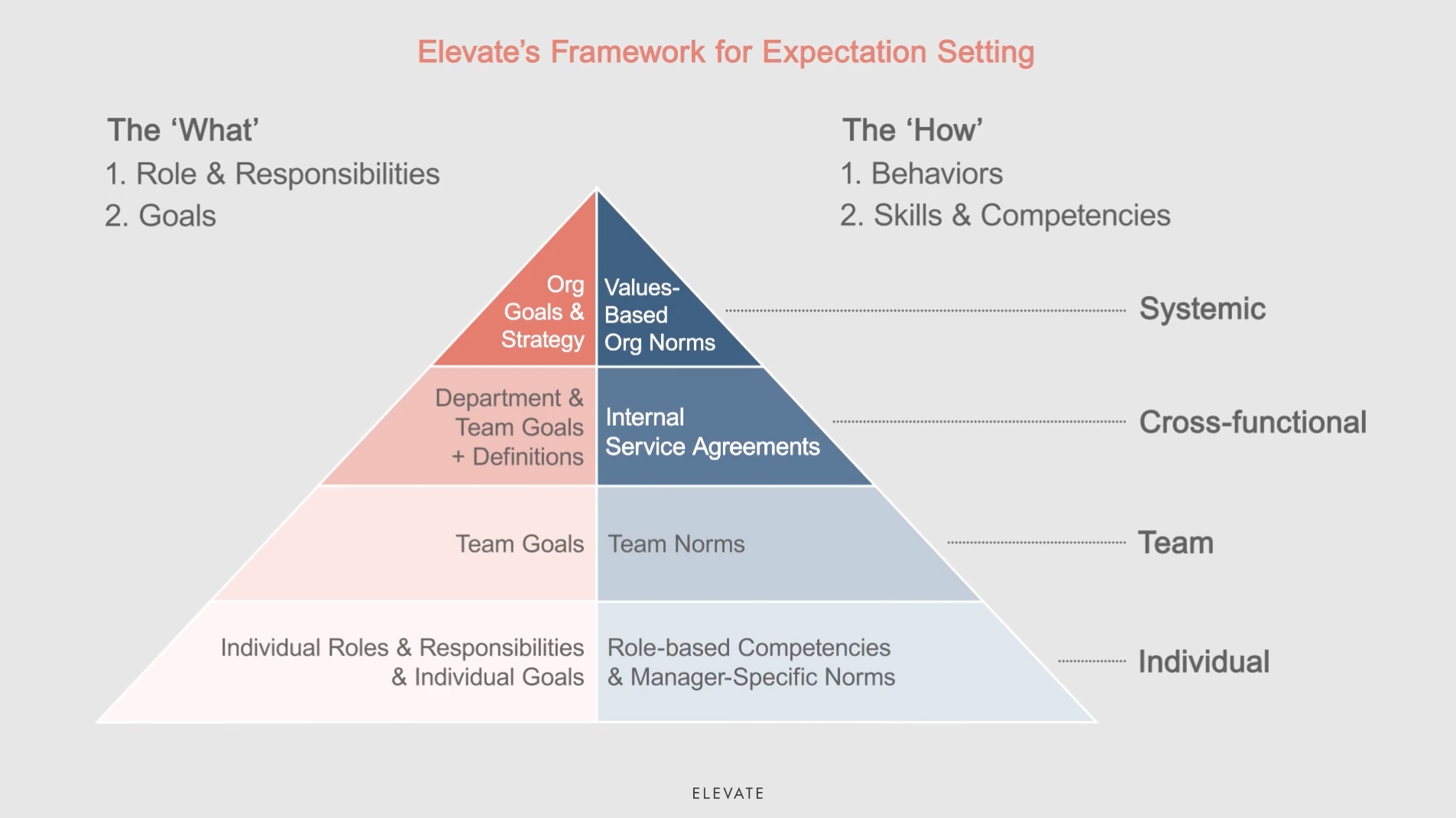
We’ve defined what expectations are, but setting them as a manager in practice can feel overwhelming. So, where do you start?
At Elevate, we use the Expectations Pyramid framework. It’s structured around two main sides and applied across four distinct organizational levels.
The Two Sides of the Expectations Pyramid
The way a goal is achieved directly impacts the result, so managers must make both sides of the pyramid crystal clear:
- The "What": This defines what people are trying to accomplish and includes specific roles, responsibilities, and goals.
- The "How": This defines the way work is meant to get done and includes the necessary behaviors, skills, and competencies.
The Four Levels of Expectations
To build a high-performing team, managers must define the "What" and the "How" across four different levels of the organization, starting from the ground up:
1. Individual Level
- The "What": Specific roles, responsibilities (such as job descriptions and project assignments), and individual goals.
- The "How": Role-based competencies and manager-specific norms. For example, setting clear guidelines for how an employee should manage up, provide updates, or ask you for help.
2. Team Level
- The "What": Clarifying team goals so individuals understand how their daily work fits into the bigger picture of the group’s outcomes.
- The "How": Establishing team norms. These are the agreed-upon behaviors for how the team works together, such as protocols for running inclusive meetings or expectations around deep-work hours.
3. Cross-Functional Level
- The "What": Explicitly communicating your team's function and goals to other departments to avoid confusion or overlapping efforts.
- The "How": Setting internal service-level agreements. This dictates how other teams should interact with yours (e.g., the proper process for submitting a request to your design team).
4. Systemic Level
- The "What": Translating overarching organizational goals and strategies for your team. You aren't creating these goals, but it is your job to provide the context so your team understands the "why" behind their work.
- The "How": Reflecting organizational norms, which are typically based on company values. For example, if the company values speed over perfection, that macro-norm must dictate how your team operates day-to-day.
{{blogcta3="/style-guide"}}
How to Set Expectations as a Manager using Elevate’s Framework

You have your expectations laid out across the pyramid. You now know the "what" and the "how". But the reality is, awareness exists on a spectrum. Just because your team knows expectations exist doesn’t mean they fully understand them or prioritize them correctly.
Complete cluelessness is on one end of the spectrum, and a mind-meld is on the other. You’re not required to achieve a mind-meld, but you want to get as close to it as possible.
To ensure true alignment most of the time, consider using these five strategies:
1. Document and Ensure Accessibility
Do not rely on verbal agreements or assumptions. Write down all roles, goals, and norms, and ensure they are easily accessible to every team member. Whether it’s a team charter, a shared Google Doc for one-on-one agendas, or a documented OKR tracker, having an objective record removes ambiguity and provides a baseline for accountability.
2. Revisit Expectations Frequently
Expectations are not "set it and forget it." Business needs naturally shift, and your expectations must shift with them. Goals should be reset quarterly and reviewed at least monthly. Broader expectations, like team norms and role responsibilities, should be reviewed every six months to ensure they are still serving the team.
3. Create Bidirectional Feedback Loops
Managers should regularly ask direct reports if their expectations are clear, aligned, and achievable. Simultaneously, managers must provide ongoing feedback on where employees are exceeding or missing the mark.
Feedback loops are critical for retention. According to a survey by StaffCircle, a staggering 54% of employees say they would leave an organization if they didn’t receive regular feedback and communication. Don't wait for an annual review to clarify a misaligned expectation.
4. Watch Out for Implicit Expectations
Managers must be highly vigilant about implicit expectations creeping in and undermining explicitly stated goals.
For example, you might tell your team that work-life balance is a priority (an explicit expectation). But if you heavily reward an employee for working over the weekend, you have just created an implicit expectation that weekend work is required to succeed.
Or, you might accidentally create unintended priorities by constantly asking for updates on a minor side project, causing the employee to deprioritize their core goals. Your actions must match your words.
5. Democratize the Goal-Setting Process
Whenever possible, allow employees to take the lead in drafting their own goals. Shifting the primary responsibility for defining expectations from the manager to the employee fosters psychological ownership. It also ensures that the objectives accurately reflect the granular realities of their day-to-day role, rather than a top-down assumption of what their job looks like.
Clarity is Kindness
As managers, we often avoid setting rigid expectations because we want to be perceived as flexible or easy to work with. We worry that too much structure will stifle our team or make us look like micromanagers.
But the opposite is true, clarity is kindness.
When you leave expectations unsaid, you’re giving them anxiety. You’re forcing them to guess what you want, how you want it, and what it takes to succeed. This ambiguity leads to frustration and a loss of trust.
By using the Elevate Expectations Framework, you take the guesswork out of the job. You provide a clear roadmap for both the "what" and the "how", allowing your employees to stop worrying about office politics and start focusing on doing their best work.
When you master the skill of setting expectations as a manager, you prove to your team that you’re an accountable, supportive leader who’s deeply invested in their success.


