

The Most & Least Stressed Cities in the U.S. in 2026
Stress is shaped by more than what happens at work. Long commutes, rising housing costs, family expenses, public safety, and access to healthcare all play a role in how people experience daily life. For many Americans, these pressures overlap, making it harder to stay healthy and maintain a sustainable rhythm between work and home.
At Elevate Leadership, we help organizations build healthier, more effective workplaces. While employers can’t control every stressor employees face outside of work, they can better understand the realities shaping their people’s lives. Stress affects decision-making and the way people show up for their teams.
To better understand where stress is highest and lowest in the U.S., we analyzed thousands of data points across the 100 most populous cities. Metrics included unemployment, commute times, income, housing affordability, childcare costs, separation and divorce rates, healthcare access, and crime rates. We also incorporated our prior Best Cities for Work-Life Balance in 2026 ranking as part of the analysis.
Together, these factors shaped our ranking of the Most and Least Stressed Cities in the U.S. The results reflect where residents may face the greatest daily pressures, and where city conditions may make it easier to maintain stability and quality of life.
Top 5 Least Stressed Cities in the U.S.
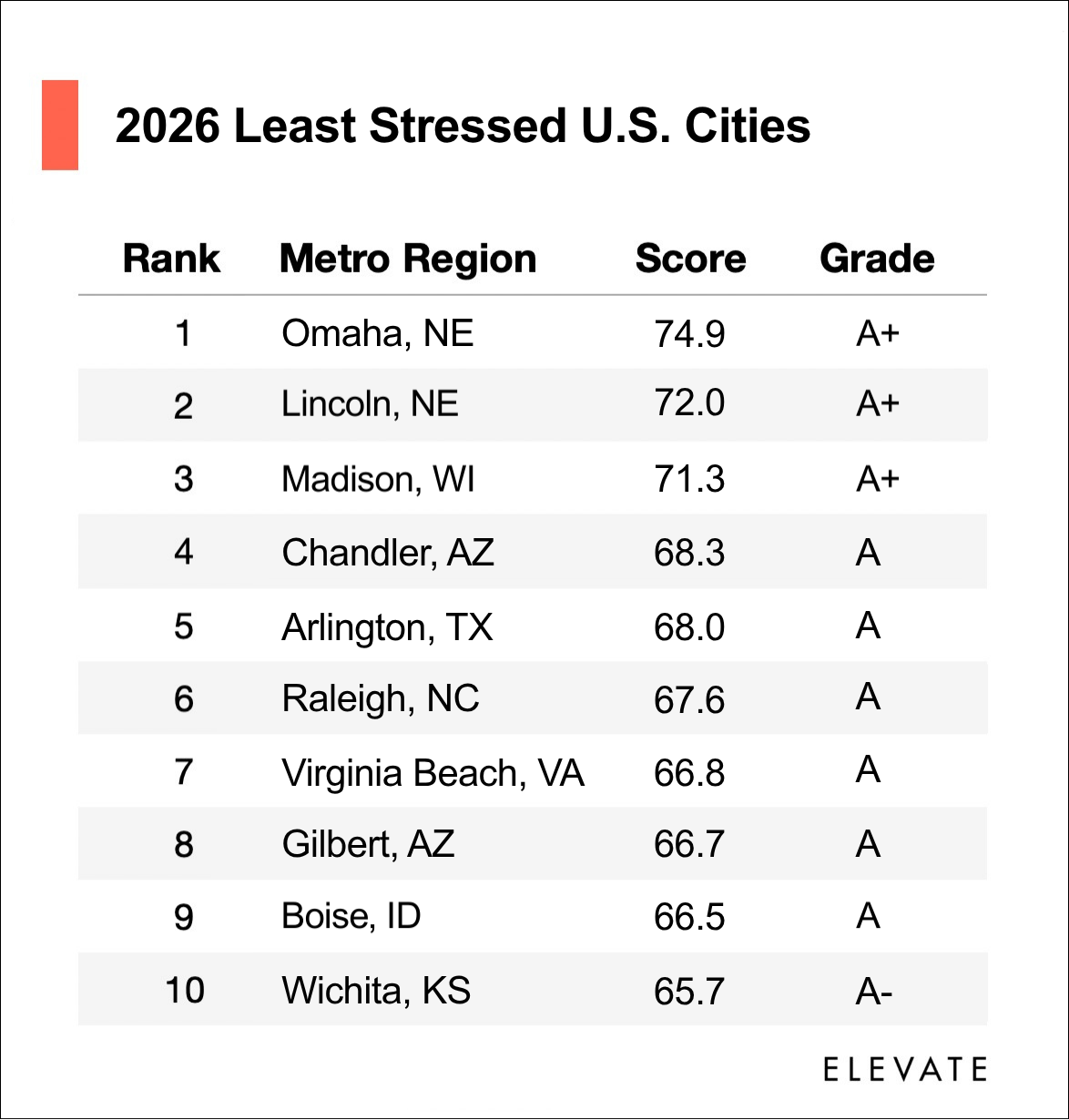
1. Omaha, NE
Omaha has the least stressed residents in the country. Known for its strong job market and affordable cost of living, Omaha performed especially well across employment and financial stress metrics. The city has a low unemployment rate of 3.6%, an average commute time of just 20 minutes, and a strong labor force participation rate of 83.1%. Omaha also stands out for affordability, with median one-bedroom rent at $1,000. Combined with a work-life balance score of 70.8, ranking 11th out of 100 cities, Omaha offers residents a strong mix of stability and everyday livability.
2. Lincoln, NE
As Nebraska’s capital, Lincoln is known for its college-town energy, short commutes, and relatively affordable cost of living. Lincoln has a low unemployment rate of 3.2% and a strong labor force participation rate of 86.3%. Families also benefit from manageable childcare costs, which account for 12.4% of median household income. With an average home value of under $285,000 and a work-life balance score of 78.8, it’s no surprise Lincoln also ranked #2 out of 100 cities in our Best Cities for Working Families study.
3. Madison, WI
Madison ranked as the third least stressed city in the country. Known for its strong healthcare sector and active outdoor culture, the city performed well across employment, safety, and quality-of-life metrics. Madison has the lowest unemployment rate among the top five least stressed cities at 2.8%. It also stands out for family stability, with the lowest separation and divorce rate in this group at 8.7%. Madison also ranked #7 out of 100 cities in our Best Cities for a Career Change study, showing its strength as a place where career opportunity and quality of life can go hand in hand.
4. Chandler, AZ
Located in the Phoenix metro area, Chandler is known for its strong employment base and family-friendly suburban feel. The city has the fourth least stressed residents in the country, driven by strong household income and low safety-related stress. Chandler has the highest median household income among the top five least stressed cities at around $103,000, helping offset higher housing and cost of living pressures. It also has the lowest annual crime rate among the top five, at 16.37 per 1,000 residents. With median one-bedroom rent at $1,490 and childcare costs accounting for 11.5% of median household income, Chandler offers residents a strong mix of income stability and livability.
5. Arlington, TX
Arlington is known for its central location between Dallas and Fort Worth, major sports venues, and family-friendly attractions. The city rounds out our least stressed cities in the country list. Arlington has the highest labor force participation rate among the top five at 88.3%, along with median one-bedroom rent of $1,120 and childcare costs accounting for just 10.2% of median household income. It also has the lowest rate of adults lacking health insurance in this group at 6.2%. Together, these factors help make Arlington a more manageable place for residents balancing work, family, and everyday expenses.
Other cities that ranked in the top 10 least stressed cities include Raleigh, NC; Virginia Beach, VA; Gilbert, AZ; Boise, ID; and Wichita, KS. These cities reflect a mix of strong job markets, family-friendly environments, and more manageable affordability pressures. Raleigh and Boise continue to stand out for career opportunity and quality of life, while Virginia Beach and Gilbert offer strong livability for families. Wichita rounds out the top 10, supported by a lower cost of living compared to many larger U.S. cities.
Top 5 Most Stressed Cities in the U.S.
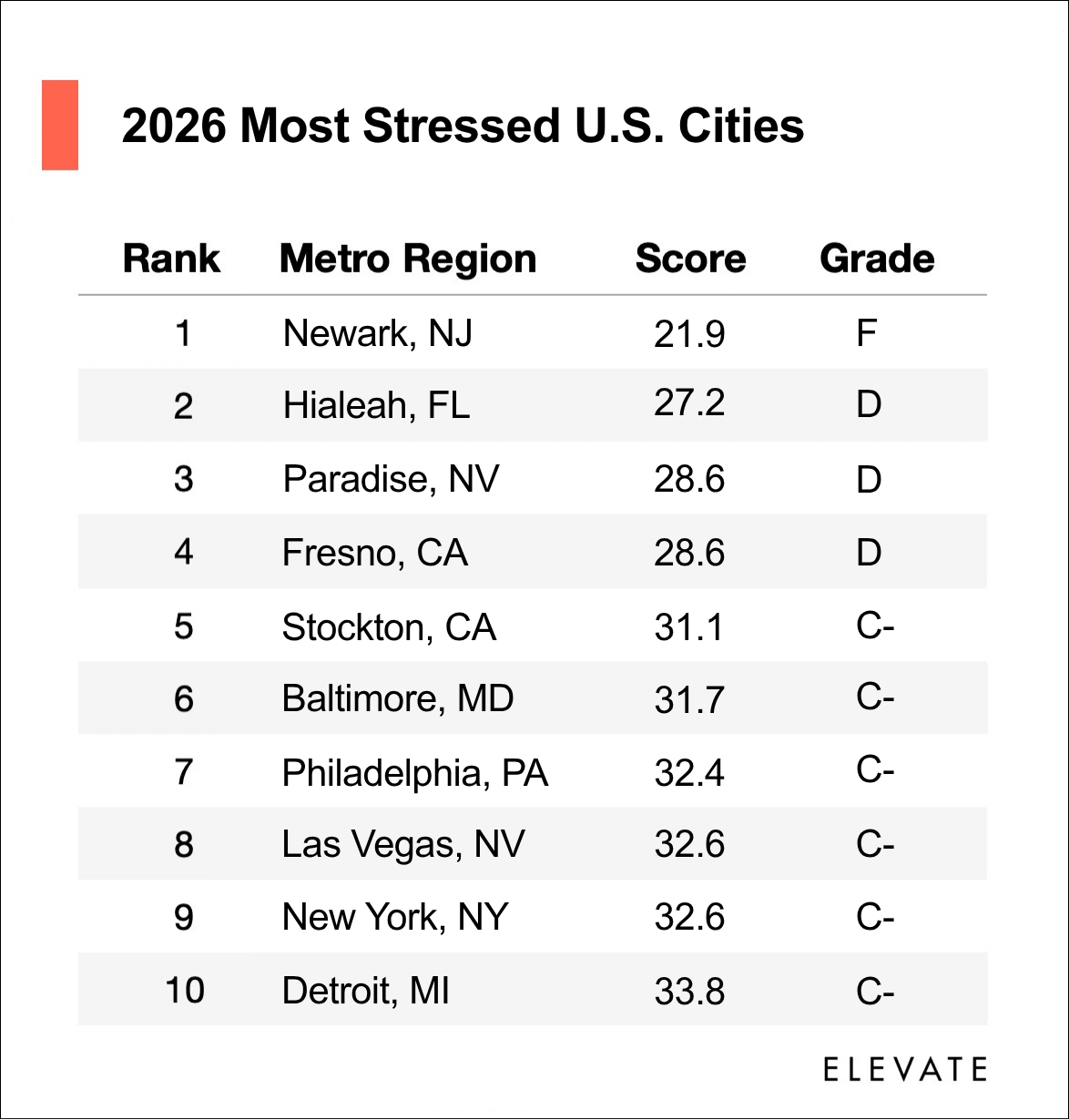
1. Newark, NJ
Newark ranked as the most stressed city in the United States. Located just outside NYC, Newark is a major transportation and business hub, but residents face notable affordability and commute-related pressure. The city has a median household income of $48,416, while median one-bedroom rent is $1,650. Newark also has the highest cost of living score among the top five most stressed cities. With an average commute time of 33 minutes and a work-life balance score of 30.5, Newark residents may face added strain across both daily logistics and overall quality of life.
2. Hialeah, FL
Hialeah came in as the second most stressed city in the U.S. on our list. Part of the greater Miami area, Hialeah is known for its dense neighborhoods, strong Cuban American identity, and deep ties to South Florida’s culture and economy. While Hialeah has a low unemployment rate of 2.7%, affordability remains a major stressor. The city’s median household income is $53,079, while median one-bedroom rent is $1,800. Hialeah also has the highest separation and divorce rate among the top five most stressed cities at 18.82%, along with a low work-life balance score of 29.8.
3. Paradise, NV
Paradise earned the third spot on our list of the most stressed cities in the U.S. Best known as home to much of the Las Vegas Strip, Paradise is closely tied to the tourism, hospitality, and entertainment industries. The city has an unemployment rate of 5.9%, a median household income of $58,874, and median one-bedroom rent of $1,500. Family and safety-related stress also contributed to its ranking, with childcare costs accounting for 15.2% of median household income and an annual crime rate of 36.90 per 1,000 residents. Together, these factors point to the pressure residents may experience behind the city’s visitor-facing economy.
4. Fresno, CA
Located in California’s Central Valley, Fresno is a major regional hub known for its agricultural economy and proximity to Yosemite, Sequoia, and Kings Canyon National Parks. It placed fourth on our list of the most stressed cities in the U.S., with employment, childcare, and safety metrics contributing to its ranking. Fresno has the highest unemployment rate among the ten most stressed cities at 8.9%, along with a labor force participation rate of 70.6%. Childcare costs account for 17.1% of median household income, the highest share among the top five most stressed cities, and the city’s annual crime rate is 40.88 per 1,000 residents.
5. Stockton, CA
Stockton rounded out the top five most stressed cities in the U.S. It has a relatively high unemployment rate of 6.8%, and a low labor force participation rate of 68.6%. It also has one of the longest average commutes among the cities highlighted at 31.1 minutes. Affordability also remains a challenge, with a high cost of living score and an average home value of $444,000. Combined with the lowest work-life balance score among all ten cities featured in this report at 26.9, these factors suggest Stockton residents may face stress from both economic conditions and day-to-day quality-of-life pressures.
Other cities that ranked in the top 10 most stressed cities include Baltimore, MD; Philadelphia, PA; Las Vegas, NV; New York, NY; and Detroit, MI. These cities reflect a mix of city stressors, including affordability challenges, commute pressures, and broader cost-of-living strain.
Methodology
To calculate our rankings, we created indices across categories tied to common sources of stress: employment, finances, family life, and health and safety. Each category included multiple metrics, which were standardized and combined to determine overall city rankings. See each source below.
Employment Stress (40%)
Unemployment Index (10%)
This data was sourced from the U.S. Census Bureau’s most recent ACS dataset.
Hour Commute Index (5%)
This is based on the percentage of workers with a commute longer than 60 minutes. Data comes from the U.S. Census Bureau’s most recent ACS dataset (1 year American Community Survey).
Labor Force Participation Index (10%)
This statistic is calculated by the total number of workers in the labor force who were unemployed, divided by the total labor force in each city. Data comes from the U.S. Census Bureau’s most recent ACS dataset (1 year American Community Survey).
Median Household Income (15%)
This data was sourced from the latest U.S. Census Bureau dataset.
Financial Stress (30%)
Rental Housing Affordability Index (10%)
This index was calculated by dividing each city’s annual median rental costs by its annual median household income to reflect what percentage housing costs are relative to local earnings. Rental costs were gathered from Zumper in May 2026.
Single Family Home Affordability Index (10%)
This index was calculated by dividing each city’s average single-family home value by its median household income to measure how attainable homeownership is based on local earnings. The average home value was sourced from Zillow in May 2026.
Cost of Living Index (10%)
BestPlaces.net cost of living scores were measured based on the costs of food, utilities, transportation, healthcare, and childcare.
Family Stress (10%)
Separation & Divorce Index (5%)
This is based on the percentage of males and females separated and divorced. Data comes from the U.S. Census Bureau’s most recent ACS dataset (5 year estimates).
Childcare Cost as % of Income Index (5%)
This is the percentage of toddler center-based daycares as a share of median family income. This was sourced from the Women’s Bureau - Department of Labor.
Health & Safety Stress (20%)
Work Life Balance Index (10%)
This index was calculated from a previous Elevate Leadership data study, The Best Cities for Work-Life Balance in 2026, we conducted in January 2026.
Crime Rate Index (5%)
This is based on the number of violent and property crimes committed per 1,000 residents by city. Data was sourced from Neighborhood Scout in May 2026.
Share of Adults Who Couldn’t See a Doctor Because of Cost Index (5%)
This is based on the percentage of the current lack of health insurance among adults aged 18-64 years old. Data was sourced from the most recent data published by Centers for Disease Control and Prevention.


